
In my last post, we saw that many firms badly misconstrue what marquee customers are, and miss out on the tremendous leverage they can exert on the growth of their business.
Marquee customers can create a much larger impact than many companies think. We’ll show how by looking not just at how they impact the customer journey, but at how they can dramatically impact your firm’s strategic imperatives. For the most accomplished firms in our Advanced Practices in Customer Advocacy and Engagement research, marquee customers are the “point of the spear” for their growth strategy.
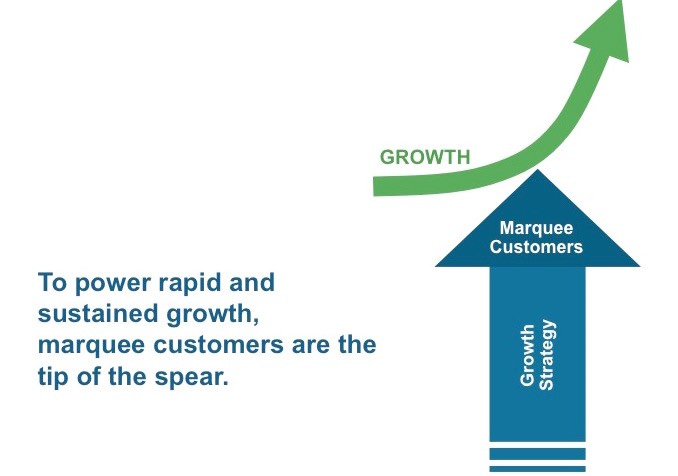
For example, marquee customers can:
Exert Powerful Influence on Your Market
Salesforce’s MVP (Most Valuable Professional) customers—its version of marquee customers—have for years exerted a huge influence on its massive customer community (which now numbers in the millions) and on the firm’s overall market. Yet there are just 145 of them. That tiny number of MVPs generate 5% to 7% of all Twitter mentions of Salesforce. They provide a prime channel for blasting out news of the firm’s new product releases. The firm’s product teams have grown dependent on the MVPs to provide incisive feedback on new products, as well as testing. And the MVPs play important leadership roles in the firm’s community—posting information on new releases, commenting on questions that come up, presenting and leading panels at Dreamforce– the firm’s huge annual conference, and in general making the community valuable to customers and attractive to prospects in its market. One internal study found that community members are 32% more likely to adopt new products than the average customer—which is very likely due to the influence of the MVPs.
Play Key Roles in Entering New Markets
Microsoft marquee customers (also called MVPs) have historically played similar, wide-ranging roles in the firm’s strategy. When it first started entering unfamiliar global markets, the firms took a strategic approach to its MVPs in those regions. A key component of the strategy was to identify prospects in new markets who were already influential through blogging or presence at local developer events.
By the time Microsoft launches in the region, it has relationships with local MVPs who help educate their communities about the new offering. As the relationships grow, so do the MVPs’ influence, which has become extraordinary. Though just a fraction of the firm’s total customer base, the MVPs provide more than 20% of the firm’s content historically—such as white papers, webcasts, and the like—on the firm’s websites and forums. In addition, the MVPs are quite willing and quite good at testing new products, providing 27% of actionable feedback—and helping to ensure good buzz when they’re launched. The MVPs are also a major resource and content destination supporting Microsoft developers, technology professionals, and Microsoft consumers.
Pull Your Firm Towards Your Future
Anyone who’s started a new line of business knows it’s tough to create—and maintain—a compelling value proposition.
Marquee #customers will help to perfect your #value proposition like an elite coach. Click To TweetCitrix, for example, has a marquee customer council that includes executives from Aetna, Johns Hopkins, New York-Presbyterian Hospital, Morgan Stanley, and many other widely known firms, which provides superb guidance on strategy to the firm’s senior leadership, as well as advocacy.
If you bring a compelling vision along with your innovative solution, marquee customers will pull you toward your future as a company. Marquee customers were key, for example, to Rackspace’s successful conversion away from the increasingly commoditized business of providing server and storage capacity, or cloud infrastructure, and toward an overall cloud management for clients regardless of the technology platforms they use.
Dan Goodgame, the firm’s vice president of executive communications, tells the story:
“By staying closely engaged with our customers and their evolving needs, we can let them pull us toward our future. I say ‘pull’ because what they want from us is almost always something annoyingly difficult to deliver that, at least in the beginning, we’d rather not do. After all, to paraphrase Tom Hanks in A League of Their Own, if it were easy, everyone would be doing it, and the customers wouldn’t be asking us for it.
“In our earliest years, customers pulled us toward making our expert engineers easily available 24/7 by phone or email or text—the beginnings of Fanatical Support. We started out as a Linux shop, but many customers wanted us to also support their Windows deployments, so we did. Then they asked us for help with network security and email and Sharepoint and website hosting and live backup. They asked us to build a cloud that was open and free from vendor lock-in. They asked us to support them not only on that OpenStack cloud but also on all of the leading public and private cloud platforms.
“With each of these, we at first would sigh and put our hands on our hips and say, ‘Really?’ And then we’d remember: When we begin to hear the same ask from lots of engaged customers, it’s a precious message from the future. And we’d get to work on an answer.”