
I’ve worked with more than a few firms who are bold about winning marquee customers, yet remarkably bashful about engaging them in advocacy. On the other hand, many firms regard pursuing marquee customer advocacy as a chimera—it’s too hard. Objections include: Marquee brands have ironclad policies against endorsements. Marquees are besieged by countless vendors; why would they say yes to us? If your solution involves security for your marquee, doubly impossible. “You have to be a GE or IBM to have a chance at advocacy or co-branding from a marquee customer” is a common sentiment.
What a waste. Several of the Advanced Practices firms from our recent study have overcome all of these objections—misconceptions, really— with marquee customers. Underlying all of them is the assumption that customer advocacy programs have little if any, value to offer customers. And so they resort to incentives, rewards, quid pro quo arrangements, and other ethically shaky inducements. Approaching marquees with these: not a good idea.
In fact, such inducements are entirely unnecessary to motivate passionate advocacy by your marquees, as many Advanced Practices firms are showing.
Here’s a framework for how they do so:
Realize that advocacy is in your marquee customer’s interest.
That’s the first thing to remember, as mentioned above—it bears repeating. Especially if you’re building relationships with marquee customer executives. Here’s how one marquee CIO, who’s worked with a number of high-profile brands, puts it: “Remember, you have some leverage. If you’re a smaller supplier or brand-new, and I’m meeting with your account manager all the time and building that relationship, I want to help that firm grow and get established. It’s in my interest. So I’m willing to do what I can to help you grow your customer base.
“On the other hand, if you’re larger and better established, you can help me reward my team by letting them go to conferences and present papers. It’s great career development for them. So again, make it part of that ongoing relationship with the account manager.”
And no, you don’t have to be a GE to get this level of advocacy. Many from the impressive collection of marquee customers that Citrix attracts to its customer council – such as Aetna, Johns Hopkins, New York-Presbyterian Hospital, Morgan Stanley, and others—also advocate for the firm.
Get personal.
It’s fairly astonishing that at many firms, no one is building long-term relationships with their best customers—even their marquees, the ones who, among other things, can pull a high- performing vendor into its proper future. Once a deal is closed, that helpful salesperson is off to the next deal. Account managers, often compensated for future sales, tend not to come around until it’s time to upgrade. Neither sales nor AMs tend to stay long at any one firm.
Some Advanced Practices firms are finding that customer advocacy managers are a better choice for filling this void. Saar Shwartz, Vice President of product marketing and analyst relations at BMC, says that his customer advocacy team has been in place around six or seven years, on average. They also tend to be “relationship” people. They’re not on commissions, and their job depends on cultivating successful customers and keeping them happy enough to tell their stories. That’s about as perfect an alignment with a customer’s interest as you’ll find in your firm.
That’s why it may make sense to put the care and feeding of marquee customers into the hands of your customer advocacy team.
Scale strategically.
“But we can’t scale that” is an understandable reaction in the cost-cutting world we’re living in, where Google says that if they have to actually talk to a customer, then they’ve done something terribly wrong.
But in fact, you can scale, and quite affordably, considering the outsized value of a marquee customer.
It doesn’t take many marquee #customers to launch and grow your #business. Click To TweetJust 50 SAS Canada customer champions led the effort to restore declining customer retention rates.
Salesforce, with a huge customer base and customer community that numbers in the millions, has just 145 MVPs.
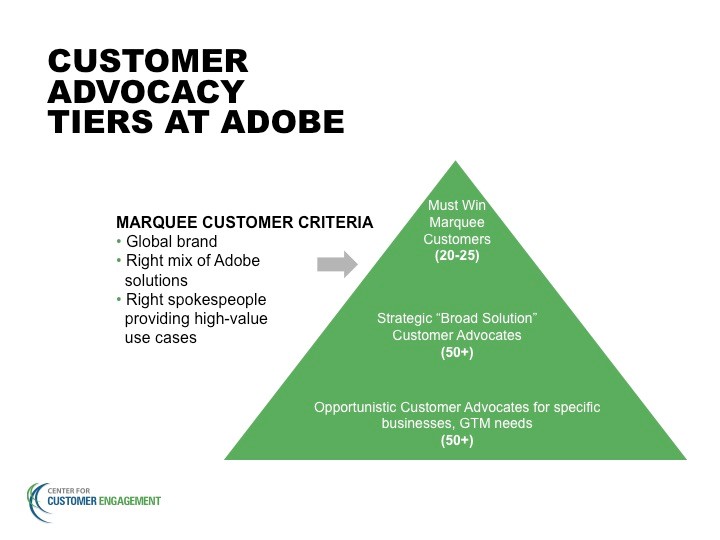
To pull off its model of assigning account managers to marquee customer advocates, Adobe tiers its customer advocates, dedicating the AMs to just 20 or so must-have marquees.
Robust marquee advocacy is well within the reach of any firm providing innovative solutions to the most influential customers in your market—and if you’re not, why be in business in the first place?
In my next post in this series on marquee customers, we’ll see how to engage really passionate advocacy from your marquees. Hint: Marquee customers, and even marquee executives—are people too.