


In reimagining how a business should operate to win today’s “empowered customer,” my last blog post posed a thought experiment: suppose the organization was run by your most desirable customers.
No, they don’t want to spend their days running your operations. But there are certain high-value outcomes from your business they most certainly do want – their needs met throughout their customer journey. And they want to hear from, and at crucial times, affiliate with your other customers.
Here, we’ll take a look at where legacy business operations inevitably go wrong.
Gaping holes in the customer journey
Here’s a typical “customer-focused” customer journey map, along with a simplified view of business activities intended to usher the customer through their journey.
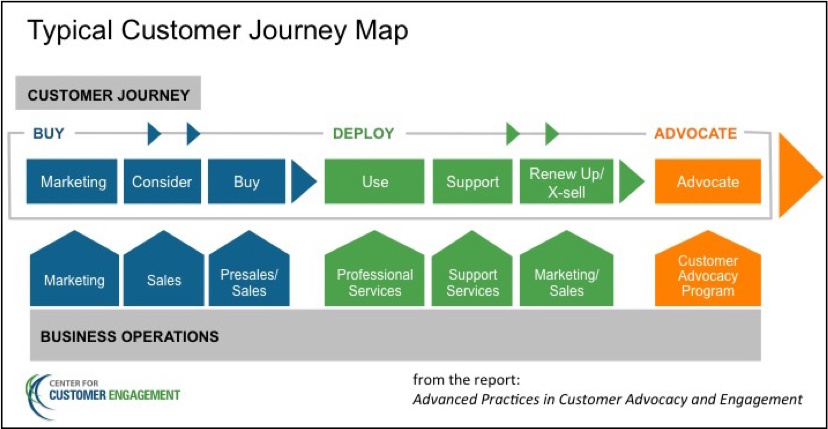
A couple of problems are readily apparent. For example, “up sell” and “advocate” aren’t needs that customers perceive—they describe business objectives. Also, customers don’t exactly regard advocating for a vendor as an exciting destination in their journey.
More importantly, if you look at how the business activities that affect the customer journey are measured, their objectives don’t match customer needs. In fact, they’re often at odds with customer needs.
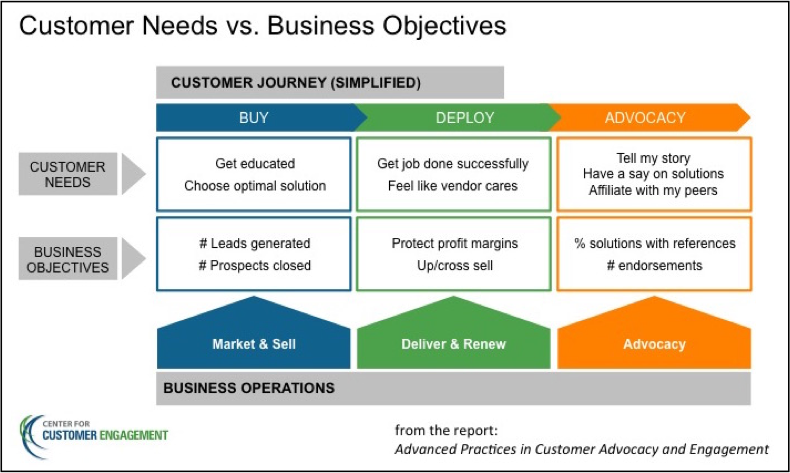
For example, when you come to the attention of a prospect who doesn’t know you during the “Buy” phase of the journey, she wants to know if you’ll honestly educate her and can provide optimal solutions (see simplified customer journey map, above). But marketing, meanwhile, is focused on snagging a qualified lead and closing deals. In the post-sale “Use and Expand” stage—a time when that ultra-helpful salesperson has become really busy or has disappeared altogether—the customer wonders if these support strangers actually care, or for that matter understand what she needs to accomplish. Customer support, meanwhile, is focused on things like resolution times, protecting profit margins, and renewing contracts.
And then there’s the “Engagement” part of the journey, where successful customers are interested in deepening their commitment to you in highly lucrative ways. Firms, meanwhile, focus on getting them to advocate. The very suggestion that a prospective customer advocate has distinct—and often compelling—needs that advocacy initiatives are well suited to meet—is often met with a blank stare. Or with a description of the various incentives, discounts, or other inducements offered to customer advocates (which don’t meet legitimate needs and are increasingly frowned upon by the Federal Trade Commission).
These misalignments create gaps throughout the customer journey. Click To TweetThe result: too many less-than-successful customers and too few passionate advocates.
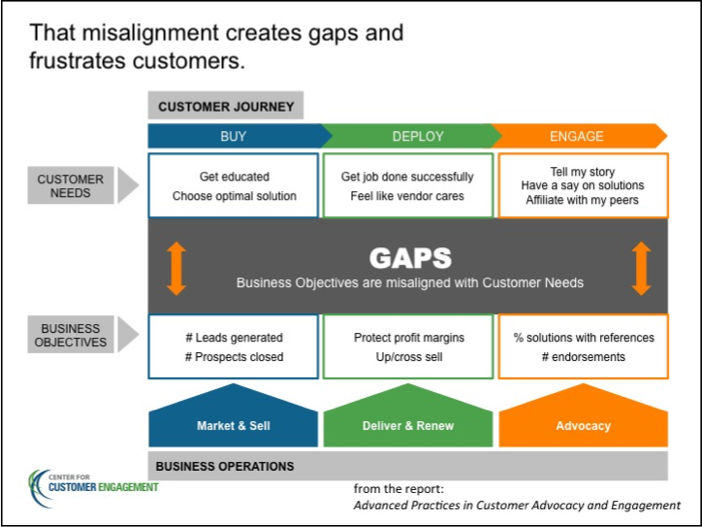
And that, folks, is where legacy business operations go wrong.
How do you fix such a fundamental problem in legacy business operations? It’s a matter re-orienting business operations into what can be called a Total Customer Experience operation. That’s the subject of my next two or three blog posts.
Want to know the essential steps for creating a holistic customer strategy that creates successful customers? Download “Executing a Billion Dollar Customer Strategy” – my free whitepaper resource!
