


For especially complex initiatives that require substantial organization changes—such as this one—an excellent option is to consider a beachhead approach. One indication of its effectiveness comes from a surprising source: Hewlett-Packard Enterprise (HP Enterprise) during its last two years under CEO Carly Fiorina. The firm was riddled with serious conflicts in the executive suite and board room and was slowed down further by a famously consensus-based culture. Despite such roadblocks, HP Enterprise was able to pull off dramatic improvements in customer-centricity and revenues.
Specifically, management wanted to reorient its customer relationships—as well as customers’ perceptions of the firm—from transactional vendor to trusted advisor. Their approach was a stunning success, despite the turmoil all around.
The framework they used was:
In addition to following the above principles: set an ambitions business objective and narrow your scope to what customers really do value:
- Establish a beachhead. Rather than an immediate reorg, the approach starts with a more modest yet more powerful launch that creates quick, dramatic wins. That’s what the HPE team did, which then provided a “beachhead” from which to continue pushing the CX transformation deeper into its organization and its customer base.
- And the beachhead is? Super AIC customers[1]. Start with a manageable group of well-selected, high-potential Super AIC customers who are receptive to taking the relationship to a significantly higher level. HPE started out with just two Super AIC enterprise accounts who’d expressed strong interest in taking the relationship to a trusted advisor level.
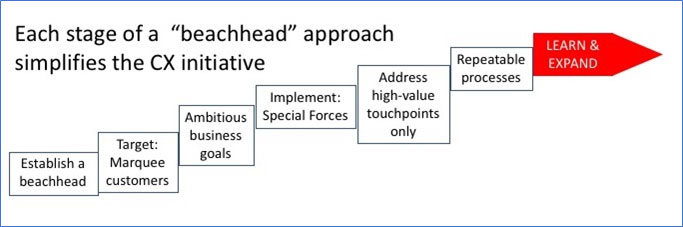
- HPE’s ambitious business objective. HPE’s management established an ambitious goal of increasing revenue growth with these customers by an average of 2X. It provided discipline as well as excitement that focused the implementation team on improvements to the CX that enterprise customers really valued—which meant these customers were happy to pay (a lot) for them. This avoids the descent into customer touchpoints madness—obsessing over every interaction.
- Implement with a small, high-performance team. The beachhead team should be a small “Special Forces” team of high performers with strong executive support, buttressed by clear, ambitious business objectives per No. 3.
- Continue rolling the CX transformation out in waves. Building on the intensive organizational learning, and the energy generated by a strong start, continue rolling out the initiative in successive waves. Rather than organizational change by fiat, this results in organic organizational change by learning.
By the way, let’s add a sixth principle to help keep that focus in these data intensive times:
- Data doesn’t drive, but it can hitch a ride when it’s ready. Of course, it’s essential to invest in analytics capabilities. But a beachhead approach doesn’t depend on or wait for state-of-the-art analytics. Instead it brings in data capabilities as they’re proven, while steaming ahead at full speed. By the way, this “move slower, buy progress faster” approach will ultimately create better data analytics.
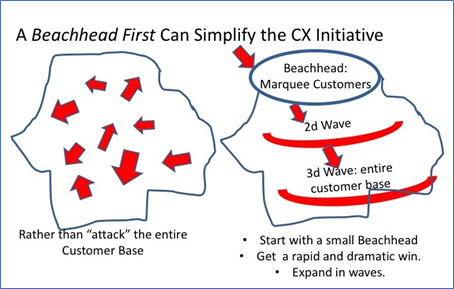 Using this approach, HPE’s initial beachhead achieved an average revenue increase of 10X,[2] along with superb gains in customer loyalty surveys—and these results don’t include additional impact from advocacy and evangelism by these thriving customers.
After establishing a solid beachhead, the HPE team took what it learned and the enhanced relationships with the beachhead customers to drive further into its enterprise customer base. HPE launched a second wave to 15 more enterprise customers just seven months after launching the initial beachhead.
The third wave, launched just a year and a half after the initial beachhead, rolled out to 50 enterprise customers worldwide. At each stage, building on the previous one, the CX initiative exceeded Executive Committee goals by wide margins.
This worked because the implementation team could experiment with models and processes, such as how sales training would look under the new customer value proposition. Getting high-profile SAIC customers on board piqued the interest of other customers. It also helped mitigate resistance from internal teams; it’s hard to argue with what your leading customers want, or the revenues they generate when they get it.
Only the firing of Fiorina in 2005 during the third wave could halt the advancement of so successful an initiative, which was cast aside in the management and board turmoil that ensued—an indication of the hardiness of the beachhead approach.
[1] “Super AIC” customer are the most potent advocates, influencers and/or contributors to growth in your market. Also called marquee customers, MVPs, flagship customers, etc., many successful firms place a high priority on winning their business and turning them into growth partners.
[2] Prior to the initiative, revenue growth for the two accounts was increasing by 5% per year. The beachhead team increased it to 50%.
