


One in a series of reports excerpted from The Hidden Wealth of Customers (Harvard Business Review Press, 2012)
EXECUTIVE SUMMARY
Overview
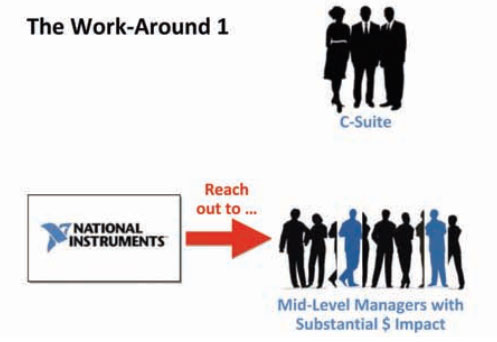
For years, Austin-based National Instruments has sold its engineering systems and software solutions to mid-level managers. But the highly respected firm (6500 employees, more than $1B in revenue) believed it could provide more strategic solutions for sale to higher-level decision makers. Equally important, so did many of its mid-level buyers. Here’s how NI leveraged those mid-level buyers to get to the C-Suite—and how you can too.
Why Sell to the C-Suite?
C-Level (or more precisely, decision maker) customers can provide:
- Faster decisions, larger contracts, fewer bureaucratic hurdles, less pushback
on price. - Powerful advocacy that includes access to their networks of potential buyers.
- High impact. Even for a multi-billion dollar B2B firm, just 50 or 70 such
customers might comprise 70 percent of its revenue. - Access to their corporate strategy deliberations.
- Increasing respect for your business in their industry.
Key Steps and Results
- Identify the best candidates among mid-level customers for gaining access to
their C-Suites. - Work with them to upgrade existing case studies (that focused on technical
features of NI solutions) to business impact case studies (or BICS). - Identify and engage with an executive sponsor for the project, who in turn will
help identify and recruit executive stakeholders to participate. - Engage executive stakeholders in in-depth interviews for purposes of building
the new, sexier case studies. - Use the resulting data plus quotes from executive interviewees as “door
openers” to C-Suites previously closed to your firm. - At NI, this process generated growth at twice the overall company growth,
fueling most of the firm’s recent expansion.
FULL REPORT
This report illustrates how engineering software firm National Instruments (NI), mired in selling products to mid-level buyers, moved beyond that to selling highermargin solutions to more senior executives. Notice how NI’s existing mid-level customers helped it gain access to senior levels—a particularly creative example of how its customers provide value beyond what they
purchase.
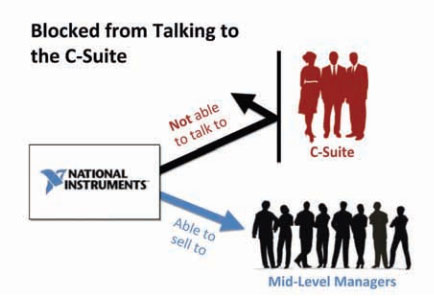
How National Instruments Gains Access to the C-Suite
For companies that already have a robust customer reference program, an obvious place to begin is to extract benchmark financial impact information from existing case studies. For companies accustomed to selling to mid-level buyers, however, the case studies likely focus on strictly technical features. That was the case at National Instruments.
When the company began a process to pursue C-Suite customers, its 600 existing case studies showed technical outcomes like how NI software could power robots, measure the flow rate of diesel nozzles, and the like. These had to change to “business impact” studies in which the writers extracted information such as reductions in total cost of ownership, improvements
in productivity and time-to-market efficiencies, and overall financial savings, as well as improvements to return on investment and payback periods resulting from NI products and solutions.
When the company began a process to pursue C-Suite customers, its 600 existing case studies showed technical outcomes like how NI software could power robots, measure the flow rate of diesel nozzles, and the like. These had to change to “business impact” studies.
Most customers didn’t have the ability to generate such numbers, so NI took that responsibility, creating a senior, cross-functional team to do so, in partnership with customers. Their goal: development of “business impact case studies” (BICS). The NI team crafted the following process to create the BICS.
NI’s Five-Step Process to Get to the C-Suite
- Identify the best candidate customers who have potentially realized the greatest financial impact, and reach out to them.
- Align the business case study efforts—working through existing mid-level customers as much as possible—to locate the appropriate executive director or vice president at the target customer
to sponsor the initiative. Ask this executive to help identify senior employees in his or her organization who can provide a complete picture of financial and business impacts. - Engage by conducting 360-degree interviews with the senior employees identified by the customer sponsor. The NI team would allocate an hour for such interviews over a period of one to two days.
- Analyze the resulting data to build a financial model for the customer’s before-and-after financial scenarios, generate the business productivity and financial impact numbers, and identify the customer’s business challenge together with the solution that the NI platform provides. This information, along with supporting quotes from senior executives, becomes the new BICS.
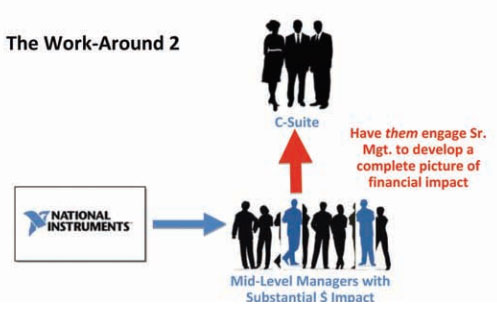 Finalize the case study by sharing it with the customer, validating the financial impact numbers, obtaining and incorporating feedback and getting necessary approvals. Publish it.
Such case studies opened doors to the C-Suite at prospective new customers by showing how they could derive powerful business benefits from NI solutions. As Dr. Sugato Deb, director of strategic development at NI, put it: “Senior executives are typically hungry for this level of business and industry insight, and very few suppliers provide that.” In addition, Deb and his
team found they were getting into extended and open conversations with executives. “We were focusing on creating business impact on a large scale. Our previous attempts to reach this level of customer and hold such conversations were much more challenging without such business insights.”
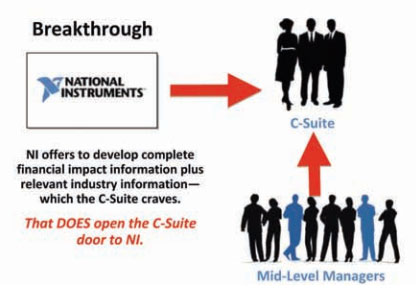 Engage with Customers to Improve Your Strategic Impact
To continue the momentum that a well-planned business impact case study effort can create, it may make sense to form customer advisory boards (CABs) from the groups of customers who have excelled in realizing business value. You’ll have a compelling value proposition: the chance to exchange ideas and develop best practices with peers who are also excelling. Of course, they’ll also want to interact with you and provide guidance on developing new solutions to address additional issues.
NI has seen its large-orders revenue grow at more than twice the rate of the company’s overall revenue growth—which is fueling most of the company’s present expansion.
The NI team formed such boards and combined the rich information they provided with its own expertise built up over years, resulting in the development of best practice themes and scorecards. The team worked with its CABs to determine which competencies—strategic, organizational, employee skills, process skills and the like—its customer firms would need in order to achieve the financial gains possible from using NI products and services. NI then created a business group to deliver the new services that arose from these conversations and to grow the
number of such engagements.
The result: NI emerged with a clear picture of the business value its customers were already receiving, an understanding of how its star customers were reaping the highest financial returns, a well-defined “best practices map” that other customers could use to help achieve such results, content-rich training tools that sales could use to engage in discussions with prospective executives about achieving such returns, and, of course, some very powerful sales collateral to leave behind or publish on its website, on social media sites, or through other media.
Over the past few years, NI has seen its large-orders revenue grow at more than twice the rate of the company’s overall revenue growth. This additional revenue is fueling most of the
company’s present expansion.
 Bill is Founder of the Center for Customer Engagement, Founder of the Summit on Customer Engagement and author of The Hidden Wealth of Customers: Realizing the Untapped Value of Your Most Important Asset (Harvard Business Review Press, 2012)